AI Ops Blueprint report excerpt.
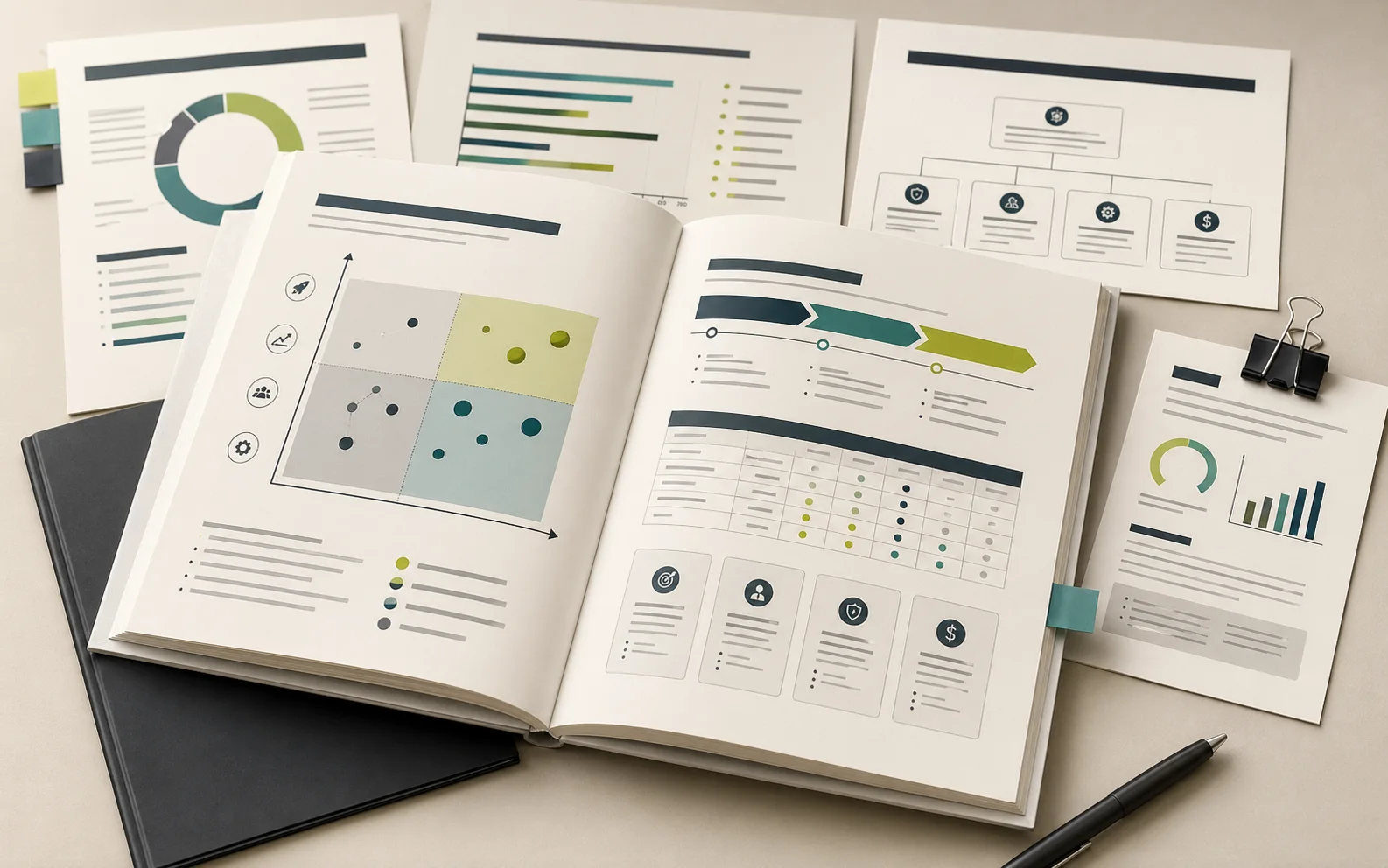
This is the shape of the paid Blueprint deliverable. The real report is customized from leadership discovery, employee signal capture, workflow evidence, ROI assumptions, and implementation constraints.
The issue was not AI literacy. It was operational drag.
The team already used AI informally, but every useful workflow lived in a different habit, account, spreadsheet, or side conversation. Leadership had no way to see which ideas were worth funding.
Recommendation: install three low-risk quick wins, validate one finance automation, and defer customer-facing autonomy until review controls and source data are cleaner.
Current state
Managers spend 8-12 hours weekly rebuilding updates from meetings, invoices, Slack threads, and customer handoff notes.
Target state
The team has a reviewed weekly operating brief, an exception queue, and a ranked backlog that prevents random AI experiments.
Not every AI idea deserves the same attention.
The Blueprint separates quick wins from major projects, fill-ins, and ideas we should leave alone until evidence improves.
Quick Wins
Low effort, visible value, safe to install immediately.
- →Meeting action capture
- →Invoice exception triage
- →Weekly ops brief
Major Projects
High value, requires access, integration, and governance.
- →Customer onboarding command center
- →Inventory exception prediction
Fill-Ins
Useful after the core bottlenecks are handled.
- →Policy lookup assistant
- →Vendor comparison prompt SOP
Ignore For Now
Too vague, low frequency, or not worth the risk yet.
- →General company chatbot
- →Autonomous customer email replies
Every recommendation gets a business wrapper.
The report does not say "use AI." It names the owner, level, setup effort, risk, cost, value assumption, and next validation step.
Ops Meeting Action System
Level 1: training and assistant
- Owner
- Operations Manager
- Setup
- 2 business days
- Cost
- $20-$60/mo
- Value
- 45 hrs/mo recovered
- Risk
- Low. Human approves every summary.
Invoice Exception Triage
Level 2: workflow automation
- Owner
- Controller
- Setup
- 1-2 weeks
- Cost
- $100-$400/mo
- Value
- $31K-$48K/yr in time and error reduction
- Risk
- Medium. Needs finance data boundary and audit log.
Onboarding Command Center
Level 3: custom workflow
- Owner
- COO
- Setup
- 4-6 weeks
- Cost
- $15K+ implementation
- Value
- $120K+/yr if cycle time drops by 30%
- Risk
- Medium. Requires CRM, email, docs, and approval workflow.
The report ends with decisions, not homework.
Install the safe wins
Meeting capture, weekly ops brief, and approved prompt SOPs for three repeated workflows.
Validate the first automation
Run invoice exception triage on historical examples, measure review accuracy, and document controls.
Build the production sprint
Deploy the highest-confidence workflow with owner, reviewer, logging, rollback, and success metrics.
Turn adoption into operating cadence
Review backlog monthly, update governance, train managers, and decide what belongs in fractional ownership.
Want the real report for your operation?
The full Blueprint includes team signal capture, leadership discovery, ranked backlog, implementation briefs, ROI assumptions, governance notes, and the executive readout.
START AI OPS BLUEPRINT